What's the one line you now add to almost every prompt?
r/PromptEngineering · Playful_Net_8756 · 60 comments
End prompts with a request for clarifying questions before the task begins; it is the most repeated fix for wrong assumptions.
liamding.com · Hong Ding
One coordinator dispatches, reviews and merges, then reports to me; every other agent owns one function. Outbound posts stay drafts until I press send, and the writer never merges its own PR.

X · HatchSystem
It doesn't write code itself; it drives Claude Code, Codex and 9+ other agents from one screen, giving each thread its own git worktree and letting you approve steps from your phone. Free, MIT, bring your own subscription.

alextang.dev · Alex Tang
Most mismatches were false alarms: invoices print "中文 / English" while delivery orders drop the slash and cut the English short. Ignoring punctuation and matching on half of either name fixed it, and real use drove the rest.
X · liyue_ai
Enable computer use, log in to the desktop client, then send one instruction covering target, boundary and error handling; the run succeeded with a screenshot check. The piece argues this differs from banned tools like WeTool because it clicks like a person rather than injecting into the client.

X · qiweiiiy
Unloading idle Chrome tabs, merging VS Code windows, running coding agents in the terminal and switching Notion to desktop tabs freed the RAM; Chrome alone dropped from 10 GB to 3 GB.

r/n8n · Ipushedhumptydumptyy · 21 comments
At 15-20 calls a week, a full voice agent is overkill; missed-call text-back asking for name, address and job usually catches most leads for far less than a monthly AI bill.
mattbrailsford.dev · Matt Brailsford
A solo newsletter operator replaced the judgement-heavy parts of weekly prep with a set of Claude skills, each paired with a rules file learned from a year of past keep/drop decisions. Weekly prep dropped from about 30 minutes to 10-15, with every write gated on one approval table.
r/ProductManagement · Plane-Ambition188 · 92 comments
Most back-and-forth comes from unclear thinking, not weak prompting: frontier models already handle ambiguous instructions better than most people, so decide the outcome before opening the chat.
warrenmar.com
Running GitHub's Spec-kit with Claude Code Auto mode, the agent worked about 4 hours unattended before hitting quota, and a weekend two-person hackathon became roughly an hour of spec writing plus an overnight run and 1-2 hours of fixes. Tests are essential to steer the agent; compaction corrupts new specs.
X · calummoore
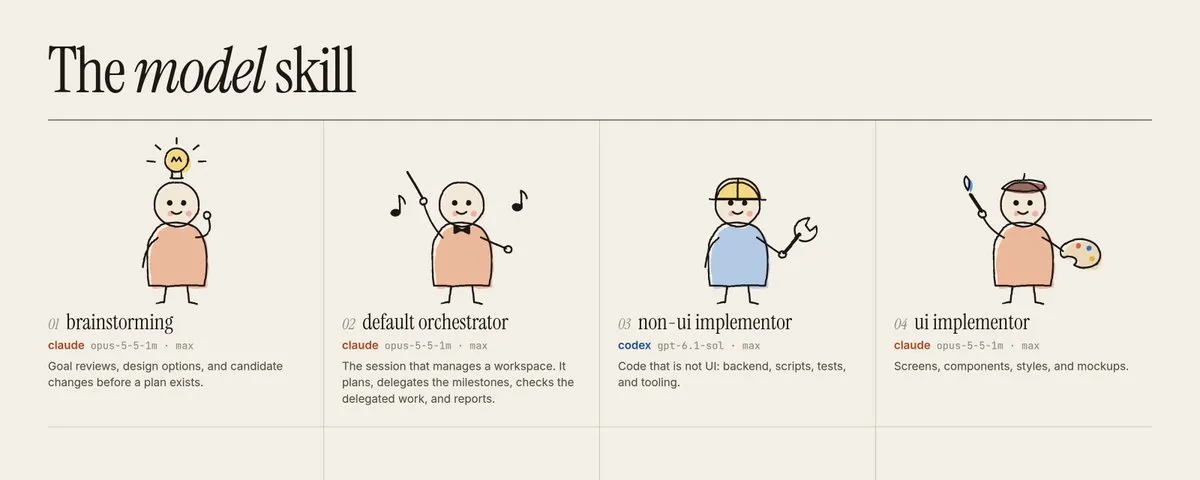
Codex is literal and strong at backend, tests and scripts but hard to steer; Claude is expansive and steerable, better for ideas, UI and orchestration. A per-task model-selection table plus a skill to make agents delegate by job.
X · BaptisteStuder_
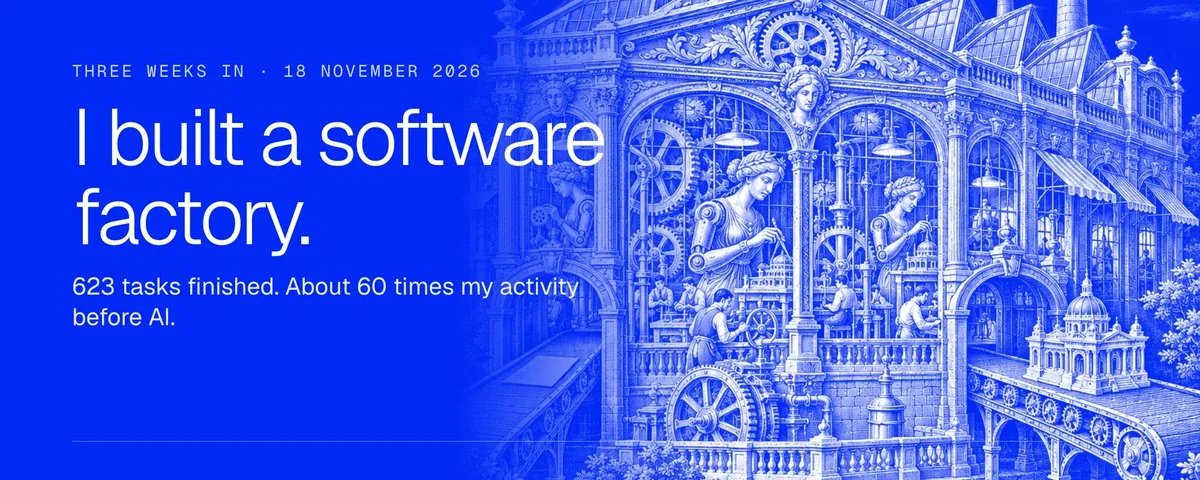
A software factory of AI agents, orchestrated by an ordinary program rather than a model's memory, finished 623 tasks, 4,653 commits and 339 reviewed PRs in three weeks. GitHub activity ran about 60 times the pre-AI baseline, with one run completing 103 tasks.
alextang.dev · Alex Tang
A build log of four AI integrations: a read-only, draft-only inbox assistant that treats message text as data, an invoice matcher that went from 2 to 92 of ~100 matches after loosening name rules, and a pipeline that retries and falls back across model providers.
christos.studio · Christos Stavrou
Over three weeks, 179 pull requests against a Ghost theme went live via Claude Code, each gated by a 150-line CLAUDE.md rule file and Ghost's gscan check before merge. 55 of the 179 were fixes, and some bugs only a separate read-only AI review caught.

blog.oceanleaf.ch · Niklas Tinner
A deliberately boring setup: a folder of Markdown context files read by Claude Code, Codex, Copilot CLI and Grok, one skill file per repeated task, scheduled agents for mail, sales, news and finance, and four cloud Grok bots. Every write passes a human gate.
X · gomezdoworks
Over about a month, four head-modeling approaches failed (TripoSR, UE Geometry Script, visual hull, ellipsoids), as did TripoSG and Tripo. The method that worked: Codex writes Blender Python, renders headless, inspects the images and fixes, about 19 minutes and 93k tokens per pass.

r/GithubCopilot · Barchimede · 73 comments
Deprecating the Local harness before the Copilot harness reaches parity signals little interest in user retention; switching tools is acceptable only if the replacement is at least as good for the same use.
blog.hoegun.xyz
After switching from web chat to local coding agents in September 2026, commits went from a handful a month to 429 in October across 17 repositories. A Slack first-response agent answered about 100 questions in two weeks, half within 90 seconds.
lennysnewsletter.com · Lenny Rachitsky
Claire reviews Claude Fable 5.2 on video generation, furniture assembly from photos, a pipeline migration and a 3D typewriter, and details how token fraud cost ChatPRD tens of thousands of dollars and why she removed free trials and promo codes. Scott Farrar shows a Claude Code plus Obsidian household system.
r/vibecoding · RUSuper · 31 comments
The economy model built on a gold simulator reflects an optimal or scripted player; real players wander and skip content, so log demo session data (gold per hour, time per zone) and tune against it instead.
mikeleembruggen.com · Michael Leembruggen
A consultant's practical method for small businesses to measure AI time savings: time one repeated task 5-10 times before switching, log the whole job including prompting and checking, track quality markers, then decide to keep, tweak or drop each workflow.
fffej.substack.com · Jeff
For messy questions, asking AI to build a small interactive tool beats asking for an answer: assumptions become knobs you can turn, and for subjective questions a shared "spreadsheet of opinions" maps where people actually disagree. The tools only need to last as long as the question.
zalt.me · Mahmoud Zalt
An AI systems architect argues the deciding test is whether a task tolerates a probabilistic answer and whether errors can be caught before they act. Exact, auditable, high-stakes work without review belongs in deterministic code; MIT and McKinsey data on failed pilots back the point.
hiroyukitsunoda.itch.io · HiroyukiTsunoda
A solo developer built a documentary-editing game in four days for an AI game jam, handing all C++ and editor scripting to Claude Code connected to Unreal Editor over MCP. The postmortem details the split of labor, the work-log practice, and the failures that became rules.
X · ridark_eth
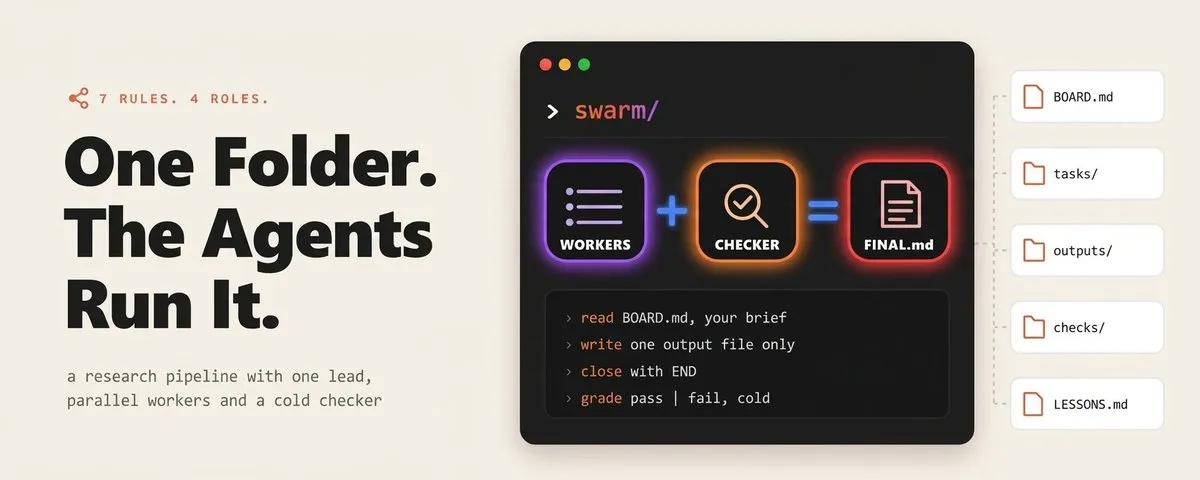
A build log for a file-coordinated agent swarm: one lead splits the job into briefs, parallel workers each write one output file, a cold checker with a different model grades each result, and the lead merges the passes. Seven rules, nine files and five saved prompts make the loop runnable unattended.
slavadubrov.com · Viacheslav Dubrov
An eight-step procedure for judging whether a harness change actually helps: pin the model, endpoint, sampling settings and machine, write tasks from the use case, hold out a test set, check actions and replies, and set thresholds before comparing. A support-assistant example shows a do-nothing design passing 8 of 16 tasks when only the database is checked.
kimdoyal.substack.com · Kim Doyal
After building 33 agents, the author now runs a team of five that only draft work for approval, after failures like near-identical Instagram carousels and a Nuelink plan capped at 365 posts that silently stopped posting.

janefriedman.com · Jane Friedman
Jane Friedman, who runs a publishing-education business, describes ten ways she uses Claude: rebuilding her WordPress search and classes pages in under an hour, a RAG chatbot over her own writing, converting newsletter issues into articles in 15 minutes instead of 2-3 hours, and automating Zoom class follow-ups.